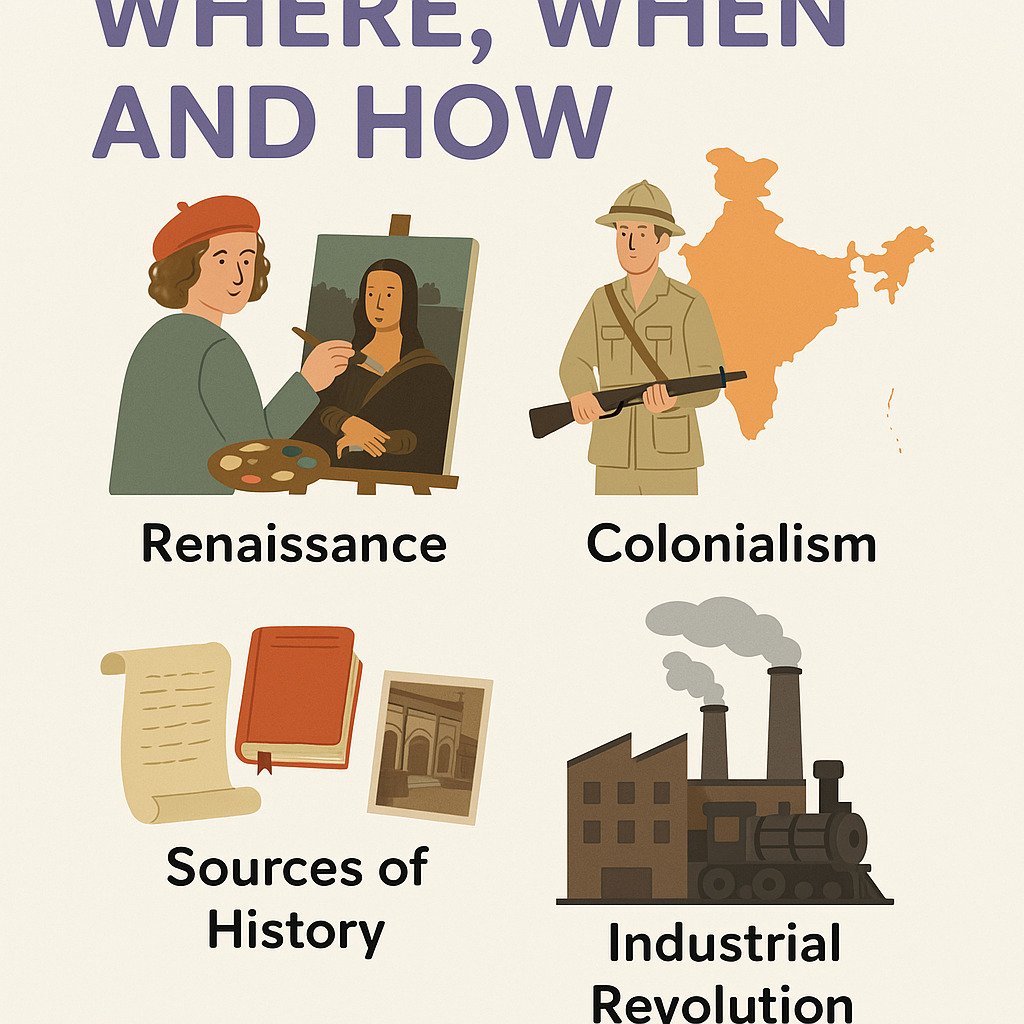
Where, When and How
History is divided into three periods:
- Ancient Period
- Medieval Period
- Modern Period
Timeline of Major Events:
- 1500: Europeans come to India for trade.
- 1707: Breakup of the Mughal Empire begins.
- 1750–1800: British complete their conquest of India.
- 1857: Revolt of 1857.
- 1900–1947: The freedom struggle continues.
- 1947: India becomes independent.
Features of the Modern Age:
- The Modern Age brought major changes in the world.
- It started with the conquest of India by the British in the 18th century.
- It continued until India’s independence in 1947.
Forces that brought change:
- Renaissance
- Mercantilism
- Industrial Revolution
- American Revolution
- French Revolution
Important Points:
- The modern period is called a period of great change.
- These changes started mostly in Europe and spread to other parts of the world.
- India (Bharat) was highly influenced by these global changes.
Forces of Change
- The Renaissance
- It was a cultural movement in Europe.
- It began in the 14th century and lasted till the 17th century.
- People started questioning blind beliefs and superstitions.
- It promoted learning, art, science, and reason.
- People were encouraged to think freely.
- Mercantilism
- It was an economic policy followed by European countries.
- From the 1500s to the 1700s, countries believed wealth meant power.
- Countries tried to produce goods within their country and reduce imports.
- They promoted trade and colonies to get raw materials.
- This system helped Europe to become rich.
- The Industrial Revolution
- It changed the world economy and society.
- It began in England in the 18th century.
- Machines replaced hand-made goods.
- More goods were produced at low cost.
- It created new industries, towns, and jobs.
- The American and French Revolutions
- These revolutions introduced new ideas like liberty, equality, and democracy.
- People began to demand rights and fair governments.
- They rejected kings who ruled unfairly.
- These revolutions inspired people all over the world.
Consequences of These Forces of Change
- Nationalism
- People began to feel pride in their country.
- It inspired freedom movements.
- Democracy
- People demanded governments chosen by the people.
- Industrialisation
- More industries were built.
- It increased production and created jobs.
- Urbanisation
- People moved to towns and cities for jobs.
- Towns grew bigger.
- Colonialism
- Powerful countries controlled weaker ones.
- They used colonies for raw materials and markets.
- India became a British colony.
- Scientific and Technological Progress
- New inventions were made.
- Human life became easier.
- Discovery of New Lands and Sea Routes
- European explorers found new lands.
- They reached India and Asia.
- Trade increased between Europe and the rest of the world.
India in the Modern World
India’s Modern Period
- The modern period in India began in the mid-18th century.
- It lasted until India’s independence in 1947.
- During this time, India came under British rule.
- The British ruled for around 200 years.
- Modern Indian history mainly covers:
- How British rule started and spread.
- How people in India resisted British rule.
- How the freedom struggle grew.
Sources of Information of Modern Indian History
This period has the most written records:
- Compared to ancient and medieval periods, the modern period has more accurate sources.
- These sources are available in printed, handwritten, and digital formats.
Main Sources:
- Primary Sources (written by people who saw the event):
- Official government records
- Letters and diaries of people
- Speeches, autobiographies, and biographies
- Newspapers and magazines
- Paintings and photographs
- Secondary Sources (written later by other people):
- History books
- Articles and essays
- Documentaries
Books, Newspapers, and Magazines
- These are important sources of modern Indian history.
- The printing press was invented in Germany in the 15th century.
- By the 18th century, the printing press became common in India.
- This allowed the mass printing of books, newspapers, and magazines.
- These printed materials helped spread knowledge and ideas.
Primary Sources of Information:
- These are created by people who saw or experienced the events.
- Examples:
- Official records
- Autobiographies
- Letters, diaries
- Speeches
- Photographs
- Paintings
- Newspapers from that time
Secondary Sources of Information:
- These are created later, based on primary sources.
- Examples:
- History books
- Articles
- Documentaries
- Biographies written later
Important Note:
- All sources must be checked for bias.
- Sometimes records may show only one side of the story.
- Example: A British newspaper from the 1857 revolt may praise British action but ignore Indian viewpoints.
- So, always read multiple sources to understand history correctly.
- Books were printed in English and other Indian languages.
- Newspapers, magazines, and pamphlets became key sources of historical information.
- Autobiographies like:
- The Story of My Experiments with Truth by Mahatma Gandhi
- An Autobiography: Toward Freedom by Jawaharlal Nehru
provide first-hand accounts of that time.
- Some foreign writers like Rudyard Kipling and E.M. Forster gave views from the British side.
- Max Mueller, a German scholar, studied Indian texts and helped spread Indian thoughts worldwide.
Government Documents
- British officials recorded all important decisions and transactions.
- These include orders, reports, letters, and other documents.
- Many of these documents are preserved in:
- National Archives of India
- National Museum, New Delhi
- Archives and museums in Chennai, Mumbai, and Kolkata
- These archives also hold letters and documents from leaders like Nehru, Gandhi, Ambedkar, and Sarojini Naidu.
Photographs and Films
- Photography began in 1839.
- It helped capture important events and daily life during British rule.
- Both British and Indian photographers recorded life, buildings, people, and art.
- Films and documentaries from that time also give us historical information.
Exercises – Multiple Choice Questions
- Which event marks the beginning of the modern period of Indian history?
a) Indian National Congress
b) The Revolt of 1857
c) The conquest of India by the British
d) The coming of Europeans to India - The feeling of patriotism and growing identification with one’s homeland is called:
a) Socialism
b) Democracy
c) Colonialism
d) Nationalism - Which of the following statements is NOT true about Mercantilism?
Answer: c) To accumulate wealth, countries should import more goods than they export. ❌
👉 Mercantilism believed in exporting more and importing less to gain wealth. - Which of the following, in your opinion, was not a direct consequence of the Industrial Revolution?
Answer: d) The ideals of liberty and equality spread rapidly around the world.
These ideals were spread mainly due to the American and French Revolutions, not Industrial Revolution. - Consider the question: “In 1980, a documentary was made on the Indian freedom struggle, based on interviews with surviving freedom fighters. Is it a primary or secondary source of information?”
Answer:
The answer given is “It is a primary source of information because it is based on interviews with people who took part in the freedom struggle.”
What is wrong with this answer?
Correct answer:
d) The documentary was made long after the freedom struggle, so it cannot be a primary source.
Although it contains interviews, the documentary itself is a secondary source because it was created later.
- Match the forces of change to the consequences
Forces of change | Consequences |
The Renaissance | Scientific and technological progress |
The Industrial Revolution | Increasing urbanisation & Industrialisation |
Mercantilism | Colonialism |
The American and French Revolutions | Democracy and Nationalism |
| | Discovery of new lands and sea routes |
One force can have multiple consequences, and multiple forces can lead to a common outcome.
III. Answer the following questions
- Name the forces of change that characterised the Modern Age.
Answer:
- The Renaissance
- Mercantilism
- The Industrial Revolution
- The American and French Revolutions
- What was the Industrial Revolution? How did it lead to urbanisation?
Answer:
The Industrial Revolution was a period of change when machines replaced hand tools.
- It began in England in the 18th century.
- Goods were produced faster and cheaper.
- Factories were built in cities.
- People moved from villages to towns for work.
- This led to urbanisation.
- What was mercantilism? Examine its consequences.
Answer:
Mercantilism was an economic policy where countries aimed to become rich by exporting more than they imported.
Consequences:
- Rise of colonies to get raw materials.
- Encouraged trade and wealth accumulation.
- Led to competition between European powers.
- What are the ideals that became popular because of the French Revolution?
Answer:
The French Revolution popularised the ideals of:
- Liberty (freedom)
- Equality (equal rights for all)
- Fraternity (brotherhood among people)
These ideas inspired people to demand fair and just governments.
- What is the meaning of nationalism?
Answer:
Nationalism is a strong feeling of pride, loyalty, and love for one’s country.
- It inspired people to fight for freedom and independence from foreign rule.
- Differentiate, with the help of examples, between primary and secondary sources of information. Which do you think would be a more reliable source of information? Justify your answer.
Answer:
Primary Source | Secondary Source |
First-hand account | Second-hand account |
Created by someone who saw the event | Created later by others |
Examples: Letters, speeches, photos | Examples: History books, articles, documentaries |
- Primary sources are more reliable as they are from the time of the event.
- But, they may still be biased.
- Best understanding comes from using both types together.
Extra questions with answers
Fill in the Blanks (With Answers)
- The history of a country is divided into ancient, ________, and modern periods.
→ medieval - The modern period of Indian history began with the conquest of India by the ________.
→ British - India became independent in the year ________.
→ 1947 - The modern period saw changes due to movements like the Renaissance and revolutions like the ________ and French Revolutions.
→ American - The ________ was an economic policy aimed at increasing a nation’s wealth through trade.
→ Mercantilism - The ________ Revolution brought about large-scale industrial changes in the 18th century.
→ Industrial - The Renaissance began in ________ and spread across Europe.
→ Italy - ________ refers to a strong love and devotion to one’s country.
→ Nationalism - Democracy is a form of government run by the ________.
→ people - The Industrial Revolution started in ________.
→ England - The Industrial Revolution led to the growth of towns and cities, a process called ________.
→ urbanisation - ________ is the control of one country over another, often for economic benefits.
→ Colonialism - New lands and sea routes were discovered during the age of ________.
→ exploration - European explorers searched for trade routes to ________.
→ Asia - The modern age promoted the use of ________ to discover scientific truths.
→ reason - The conquest of India by the British began in the ________ century.
→ 18th - The Revolt of 1857 was an important event during the ________ period of Indian history.
→ modern - The Mughal Empire broke up around the year ________.
→ 1707 - The printing press was invented in the country of ________.
→ Germany - The printing press came into common use in India in the ________ century.
→ 18th - The autobiography of Mahatma Gandhi is titled The Story of My Experiments with ________.
→ Truth - Jawaharlal Nehru wrote An Autobiography: Towards ________.
→ Freedom - Max Mueller was a German scholar who studied ancient Indian texts like the ________.
→ Vedas - British rule in India lasted for nearly ________ years.
→ 200 - The National Archives of India is located in ________.
→ New Delhi - The invention of ________ in 1839 helped record historical events.
→ photography - Many important documents are preserved in the ________ Museum, New Delhi.
→ National - Both primary and ________ sources must be checked for bias.
→ secondary - A primary source is created by someone who has ________ the event.
→ witnessed - A ________ is a written record of events from the viewpoint of the author.
→ diary - History books and articles are examples of ________ sources.
→ secondary - Newspapers and photographs are examples of ________ sources.
→ primary - The Industrial Revolution led to the growth of ________ in cities.
→ factories - The Renaissance promoted questioning of ________ and superstitions.
→ blind beliefs - The French Revolution gave rise to ideals of liberty, equality, and ________.
→ fraternity - The British maintained detailed ________ of their official transactions.
→ records - During British rule, people in India began to demand ________.
→ freedom - Many documents from British rule are stored in national and regional ________.
→ archives - ________ and films provide a visual record of historical times.
→ Photographs - The discovery of sea routes helped increase ________ between countries.
→ trade - Renaissance thinkers promoted ________ rather than blind faith.
→ scientific enquiry - Colonial powers used Indian colonies as a source of ________ materials.
→ raw - Mercantilism encouraged countries to export more than they ________.
→ import - The Revolt of 1857 is considered the first major struggle for Indian ________.
→ independence - Urbanisation led to the rise of big ________ and crowded cities.
→ towns - Official records include reports, orders, and ________.
→ correspondence - Freedom fighters’ letters and speeches are examples of ________ sources.
→ primary - Secondary sources include books written ________ the event occurred.
→ after - The Industrial Revolution changed the way goods were ________.
→ produced - The Renaissance encouraged people to think and ask ________.
→ questions
MCQs with Answers and Explanations
- Which period in history follows the medieval period in India?
a) Ancient
b) Classical
c) Modern
d) Colonial
Answer: c) Modern
Explanation: The modern period comes after the medieval period in Indian history.
- When did India gain independence from British rule?
a) 1857
b) 1757
c) 1945
d) 1947
Answer: d) 1947
Explanation: India became an independent nation on 15th August 1947.
- What event is considered the beginning of modern Indian history?
a) Formation of INC
b) Conquest of India by the British
c) The Revolt of 1857
d) Arrival of Mughals
Answer: b) Conquest of India by the British
Explanation: Modern Indian history begins with British dominance in India in the 18th century.
- The Renaissance originated in which continent?
a) Asia
b) Europe
c) Africa
d) America
Answer: b) Europe
Explanation: The Renaissance began in Europe, particularly Italy.
- The Renaissance promoted:
a) Blind beliefs
b) Magic and myths
c) Scientific thinking and reasoning
d) Feudal practices
Answer: c) Scientific thinking and reasoning
Explanation: It encouraged questioning and logic over superstition.
- Which policy promoted exports and discouraged imports?
a) Communism
b) Mercantilism
c) Capitalism
d) Socialism
Answer: b) Mercantilism
Explanation: Mercantilism aimed at increasing national wealth through trade surplus.
- What was one key consequence of Mercantilism?
a) Industrial growth
b) Creation of colonies
c) Decline of trade
d) Rise of kings
Answer: b) Creation of colonies
Explanation: European powers colonized regions to exploit resources under mercantilism.
- The Industrial Revolution began in:
a) France
b) Germany
c) England
d) Italy
Answer: c) England
Explanation: It started in England in the late 18th century.
- Which revolution spread ideas of liberty and democracy?
a) Industrial Revolution
b) Russian Revolution
c) American and French Revolutions
d) Scientific Revolution
Answer: c) American and French Revolutions
Explanation: These revolutions promoted liberty, equality, and fraternity.
- What led to the growth of towns and cities?
a) Feudalism
b) Industrialisation
c) Renaissance
d) Mercantilism
Answer: b) Industrialisation
Explanation: Factories and job opportunities in cities led to urbanisation.
- The feeling of pride and loyalty towards one’s country is called:
a) Democracy
b) Nationalism
c) Patriotism
d) Colonialism
Answer: b) Nationalism
Explanation: Nationalism involves deep love for one’s nation and the desire for its freedom.
- Democracy means:
a) Rule by a king
b) Rule by military
c) Rule by the people
d) Rule by aristocrats
Answer: c) Rule by the people
Explanation: Democracy is a system of government where people elect their leaders.
- The printing press became common in India during the:
a) 15th century
b) 16th century
c) 18th century
d) 20th century
Answer: c) 18th century
Explanation: Printing press became widespread in India by the 18th century. - Gandhi’s autobiography is titled:
a) Towards Freedom
b) My Nation, My Struggle
c) Truth and Freedom
d) The Story of My Experiments with Truth
Answer: d) The Story of My Experiments with Truth
Explanation: This is the famous autobiography of Mahatma Gandhi.
- A first-hand account by a witness is a:
a) Secondary source
b) Primary source
c) Biased source
d) Government record
Answer: b) Primary source
Explanation: It is created by someone who experienced the event.
- History books are examples of:
a) Primary sources
b) Secondary sources
c) Official records
d) Visual sources
Answer: b) Secondary sources
Explanation: Secondary sources are written after events using primary sources.
- British records were maintained as:
a) Oral stories
b) Folktales
c) Official documents
d) Mythology
Answer: c) Official documents
Explanation: British administration was known for detailed documentation.
- The National Archives of India is located in:
a) Mumbai
b) Kolkata
c) Chennai
d) New Delhi
Answer: d) New Delhi
Explanation: It holds major historical records and archives.
- Photographs are an example of:
a) Literary sources
b) Primary sources
c) Oral sources
d) Political sources
Answer: b) Primary sources
Explanation: Photos are visual first-hand records of historical events.
- Which revolution led to the mechanization of industries?
a) Renaissance
b) French Revolution
c) American Revolution
d) Industrial Revolution
Answer: d) Industrial Revolution
Explanation: Machines replaced manual labor during this period.
- Which of these is NOT a consequence of the Industrial Revolution?
a) Urbanisation
b) Growth of factories
c) Spread of liberty
d) Increased production
Answer: c) Spread of liberty
Explanation: Liberty was mainly promoted by the French and American revolutions.
- Max Mueller was a scholar of:
a) Greek texts
b) Sanskrit
c) Arabic
d) Tamil
Answer: b) Sanskrit
Explanation: Max Mueller translated and studied ancient Indian scriptures.
- Which was a key result of sea route discovery?
a) Decline in trade
b) Slower transport
c) Expansion in global trade
d) Fewer colonies
Answer: c) Expansion in global trade
Explanation: Sea routes enabled European countries to explore and trade worldwide.
- A newspaper published in 1947 about Indian independence is a:
a) Secondary source
b) Imaginary source
c) Primary source
d) Biased source
Answer: c) Primary source
Explanation: It was published at the time of the actual event.
- The American Revolution took place in the:
a) 15th century
b) 16th century
c) 17th century
d) 18th century
Answer: d) 18th century
Explanation: It occurred in 1776.
- What was the main reason behind European colonialism in India?
a) Education
b) Exploration
c) Trade and wealth
d) Religion
Answer: c) Trade and wealth
Explanation: European powers colonized to extract raw materials and expand trade.
- The French Revolution mainly introduced the idea of:
a) Industrial growth
b) Scientific thinking
c) Liberty and equality
d) National unity
Answer: c) Liberty and equality
Explanation: These ideals became global symbols of justice and rights.
- Which is a secondary source?
a) A soldier’s letter from war
b) A newspaper from 1947
c) A documentary made in 2020 on World War I
d) A government order issued in 1930
Answer: c) A documentary made in 2020 on World War I
Explanation: It was made much later and is based on existing information.
- What type of government is based on the will of the people?
a) Monarchy
b) Democracy
c) Dictatorship
d) Theocracy
Answer: b) Democracy
Explanation: Democracy means rule by the people through elected representatives.
- A painting made during the Mughal period is a:
a) Literary source
b) Political source
c) Primary source
d) Secondary source
Answer: c) Primary source
Explanation: It is created during the actual time and gives visual information.
- The term ‘industrialisation’ refers to:
a) Colonising foreign lands
b) Use of machines in production
c) Religious transformation
d) Scientific revolution
Answer: b) Use of machines in production
Explanation: Industrialisation refers to setting up factories and mass production.
- Urbanisation means:
a) Living in forest areas
b) Moving to villages
c) Growth of towns and cities
d) Agricultural expansion
Answer: c) Growth of towns and cities
Explanation: Urbanisation happened due to job opportunities in industries.
- Government records during British rule were preserved in:
a) Forts
b) Private houses
c) National Archives
d) Newspapers
Answer: c) National Archives
Explanation: Official records are stored in the National Archives of India.
- Autobiographies are examples of:
a) Fiction
b) Primary sources
c) Religious texts
d) News reports
Answer: b) Primary sources
Explanation: Autobiographies are written by people who experienced the events.
- The idea of scientific enquiry was promoted during the:
a) Mughal Era
b) French Revolution
c) Renaissance
d) British Raj
Answer: c) Renaissance
Explanation: It revived interest in science, art, and logic.
- Which of these promoted colonisation the most?
a) Industrial Revolution
b) Mercantilism
c) Nationalism
d) Democracy
Answer: b) Mercantilism
Explanation: Colonies were created to support trade and gather raw materials.
- The term “bias” in sources refers to:
a) Accuracy
b) Mistakes
c) One-sided viewpoint
d) Authenticity
Answer: c) One-sided viewpoint
Explanation: Biased sources show only one side of the story.
- The French Revolution began in which country?
a) England
b) Germany
c) France
d) Russia
Answer: c) France
Explanation: It started in France in 1789.
- Which of the following is a visual source?
a) Poem
b) Diary
c) Photograph
d) Speech
Answer: c) Photograph
Explanation: It provides visual evidence of the event.
- The main goal of colonialism was to:
a) Educate natives
b) Increase industrial jobs
c) Use colonies for trade and materials
d) Promote art and culture
Answer: c) Use colonies for trade and materials
Explanation: Colonies served economic interests of ruling nations.
- A film made during an event is a:
a) Biased source
b) Secondary source
c) Primary source
d) False source
Answer: c) Primary source
Explanation: It is created during the actual time.
- The phrase “scientific revolution” refers to:
a) Revolt against science
b) Growth in myths
c) Rise in logical and evidence-based thinking
d) Religious movement
Answer: c) Rise in logical and evidence-based thinking
Explanation: It encouraged reasoning and experimentation.
- Industrial Revolution helped in:
a) Slowing down production
b) Promoting hand-made goods
c) Mass production using machines
d) Banning factories
Answer: c) Mass production using machines
Explanation: Machines increased speed and reduced cost of production.
- Gandhi and Nehru wrote:
a) Letters only
b) Novels
c) Autobiographies
d) Speeches
Answer: c) Autobiographies
Explanation: Their autobiographies are valuable historical sources.
- Which of these promoted liberty, equality, and democracy?
a) The Renaissance
b) The Industrial Revolution
c) The American and French Revolutions
d) The British Rule
Answer: c) The American and French Revolutions
Explanation: These revolutions aimed to end monarchy and give rights to people.
- Which of the following helped spread modern ideas in India?
a) Puppet shows
b) Painting competitions
c) Printing press
d) Yoga practices
Answer: c) Printing press
Explanation: It allowed books and newspapers to reach the masses.
- Which is more reliable — primary or secondary sources?
a) Always primary
b) Always secondary
c) Depends on bias and accuracy
d) Neither
Answer: c) Depends on bias and accuracy
Explanation: Both can be useful if cross-verified and unbiased.
- A revolution that influenced other world movements was the:
a) French Revolution
b) Mughal Revolution
c) Renaissance
d) Colonial rule
Answer: a) French Revolution
Explanation: It spread the idea of people’s rights and democracy.
- Which century did the Industrial Revolution start in?
a) 16th
b) 17th
c) 18th
d) 19th
Answer: c) 18th
Explanation: It began in the mid to late 1700s in England.
- What helped preserve original documents during British rule?
a) Museums and archives
b) Palaces
c) Forts
d) Newspapers
Answer: a) Museums and archives
Explanation: These institutions keep official and historical records safe.
1 Mark Questions
- Name the three periods into which Indian history is divided.
Answer: Ancient, Medieval, and Modern periods.
- What is the time period of modern Indian history?
Answer: From the mid-18th century to 1947 (India’s independence).
- Mention any two revolutions that influenced the modern world.
Answer: The American Revolution and the French Revolution.
- Define the Renaissance in simple terms.
Answer: A movement in Europe that revived interest in art, science, and reason.
- What was the main idea behind Mercantilism?
Answer: To accumulate wealth by exporting more than importing and establishing colonies.
- What do you mean by the Industrial Revolution?
Answer: A period when machines began to replace hand-made goods, increasing production.
- Name any two effects of the Industrial Revolution.
Answer: Urbanisation and large-scale manufacturing of goods.
- Define Colonialism.
Answer: The practice of controlling and ruling over another country for economic gain.
- What are the main ideals promoted by the French Revolution?
Answer: Liberty, Equality, and Fraternity.
- What is the meaning of Nationalism?
Answer: A strong sense of pride, loyalty, and love for one’s nation.
- State any two consequences of European exploration.
Answer: Discovery of new lands and expansion of trade routes.
- What was the impact of the printing press on Indian history?
Answer: It helped spread knowledge through books, newspapers, and magazines.
- Name any two primary sources of modern Indian history.
Answer: Autobiographies and government documents.
- Give examples of any two secondary sources.
Answer: History textbooks and documentaries.
- What are government records? Why are they important in history?
Answer: Official documents that record decisions and actions of the government; they help reconstruct historical events.
- Where are most British-era official documents preserved in India?
Answer: In the National Archives of India, New Delhi.
- Name two Indian leaders whose letters and speeches are important historical sources.
Answer: Jawaharlal Nehru and Mahatma Gandhi.
- When was photography invented and how did it help historians?
Answer: In 1839; it provided visual records of people, places, and events.
- Mention two key features of the Modern Age.
Answer: Scientific and technological progress, and the rise of democracy.
- What is a primary source? Give one example.
Answer: A first-hand account created during the time of the event; e.g., letters or photographs.
- What is a secondary source? Give one example.
Answer: A source created after the event based on primary sources; e.g., history book.
- What is meant by Industrialisation?
Answer: The development of industries and factories for mass production of goods.
- How does bias affect historical sources?
Answer: Bias shows only one point of view, which may hide the complete truth.
- Name any two museums (other than National Archives) that preserve historical records in India.
Answer: Museums in Mumbai and Chennai.
- Why is it important to study both primary and secondary sources?
Answer: To get a complete and accurate understanding of historical events.
Two-Marks Questions
- What marked the beginning of modern Indian history and when did it end?
The modern period in Indian history began with the conquest of India by the British in the 18th century and ended with India’s independence in 1947.
- What are the major periods into which Indian history is divided? Explain briefly.
Indian history is divided into Ancient, Medieval, and Modern periods. These divisions help understand major changes in society, politics, and economy over time.
- What was the Renaissance and how did it affect people’s thinking?
The Renaissance was a cultural and intellectual movement in Europe that encouraged people to question old beliefs. It promoted reason, scientific thinking, and inquiry.
- Explain the term ‘Mercantilism’ with one consequence.
Mercantilism was an economic policy where European powers tried to become wealthy by exporting more and importing less. It led to the rise of colonies for raw materials and trade.
- What was the Industrial Revolution? Mention one change it brought.
The Industrial Revolution was a period of rapid industrial growth where machines replaced manual labor. It led to faster and cheaper production of goods.
- How did the Industrial Revolution lead to urbanisation?
Factories were set up in cities, attracting people from rural areas for jobs. This caused rapid growth of towns and cities.
- What were the key ideals promoted by the French and American Revolutions?
Both revolutions promoted liberty, equality, and democracy. These ideas inspired people worldwide to fight for freedom and rights.
- What is colonialism? Give one example related to India.
Colonialism is the control of one country over another to exploit its resources. India was a colony under British rule for nearly 200 years.
- Define nationalism and explain how it influenced the Indian freedom struggle.
Nationalism is the feeling of love and loyalty for one’s nation. It motivated Indians to fight against British rule and seek independence.
- How did the discovery of new sea routes affect global trade?
New sea routes helped European traders explore Asia and other parts of the world. It led to expansion in trade and establishment of colonies.
- Why is the modern period considered different from the earlier periods of Indian history?
The modern period brought major political, social, and economic changes due to British rule, revolutions, scientific progress, and the freedom movement.
- What role did the printing press play in modern Indian history?
The printing press made books, newspapers, and pamphlets easily available. It helped spread awareness and ideas during the freedom struggle.
- What are primary sources? Give one example and explain.
Primary sources are first-hand accounts created during an event, like letters, diaries, or photographs. They provide direct evidence of history.
- What are secondary sources? Give one example and explain.
Secondary sources are created after events by using primary sources, like textbooks and documentaries. They help interpret historical events.
- Why should historical sources be checked for bias?
Some sources may present only one point of view, especially British records. Studying multiple sources helps get a balanced understanding.
- Name two types of government records kept during British rule and their importance.
Government orders and official correspondence were recorded. They help historians study the decisions and administration of that time.
- What kind of information do autobiographies provide? Name any one.
Autobiographies give personal insights into events and thoughts of historical figures. Example: Gandhi’s The Story of My Experiments with Truth.
- How did photography help historians in the modern period?
Photographs recorded people, events, and places, giving visual evidence of the past. They are useful in studying British rule and the freedom movement.
- What is the National Archives of India and what does it preserve?
The National Archives is a government institution in New Delhi. It preserves official records and documents from British India.
- What is the difference between urbanisation and industrialisation?
Urbanisation is the growth of towns due to migration. Industrialisation refers to the development of industries and factories for mass production.
- Name two consequences of the Industrial Revolution apart from urbanisation.
Growth of factories and large-scale production of goods are two other key consequences.
- What kind of influence did European authors have on writing Indian history?
European authors sometimes portrayed Indians from a colonial point of view. Their writings may reflect bias or justify colonial rule.
- Why do we study both primary and secondary sources in history?
Primary sources give original evidence, while secondary sources help interpret them. Studying both ensures accuracy and deeper understanding.
- Give two reasons why the British recorded so many official documents in India.
British officials were very systematic. They kept records to monitor transactions, orders, and reports for governance and control.
- Why is the modern period in world history called the “Modern Age”?
It saw revolutionary changes in ideas, technology, governance, and production methods. It also saw the rise of nationalism and democracy.
Match the Following
Q1. Match the movements/periods with their features:
A (Movements/Periods) | B (Features) |
a) Renaissance | 1. Promotion of liberty and equality |
b) French Revolution | 2. Rule by the people |
c) Democracy | 3. Emphasis on art, science, and reason |
d) Nationalism | 4. Love and loyalty towards the nation |
Answer:
a → 3, b → 1, c → 2, d → 4
Q2. Match the historical terms with their meanings:
A (Terms) | B (Meanings) |
a) Colonialism | 1. Control over another country |
b) Urbanisation | 2. Development of industries |
c) Industrialisation | 3. Growth of cities |
d) Mercantilism | 4. Wealth through trade and exports |
Answer:
a → 1, b → 3, c → 2, d → 4
Q3. Match the historical sources with their type:
A (Sources) | B (Type) |
a) Letter from a freedom fighter | 1. Visual source |
b) Photograph of 1857 revolt | 2. Primary source |
c) History textbook | 3. Secondary source |
d) Painting of British era | 4. Artistic/visual record |
Answer:
a → 2, b → 1, c → 3, d → 4
Q4. Match the authors with their contributions:
A (Authors) | B (Contributions) |
a) Mahatma Gandhi | 1. Studied Indian scriptures |
b) Max Mueller | 2. Autobiography – Toward Freedom |
c) Jawaharlal Nehru | 3. Autobiography – Experiments with Truth |
d) Rudyard Kipling | 4. Wrote from British colonial view |
Answer:
a → 3, b → 1, c → 2, d → 4
Q5. Match the events with their timelines:
A (Events) | B (Year) |
a) Revolt of 1857 | 1. 1947 |
b) End of British rule | 2. 1857 |
c) Break-up of Mughal Empire | 3. 1707 |
d) European entry to India | 4. Around 1500 |
Answer:
a → 2, b → 1, c → 3, d → 4