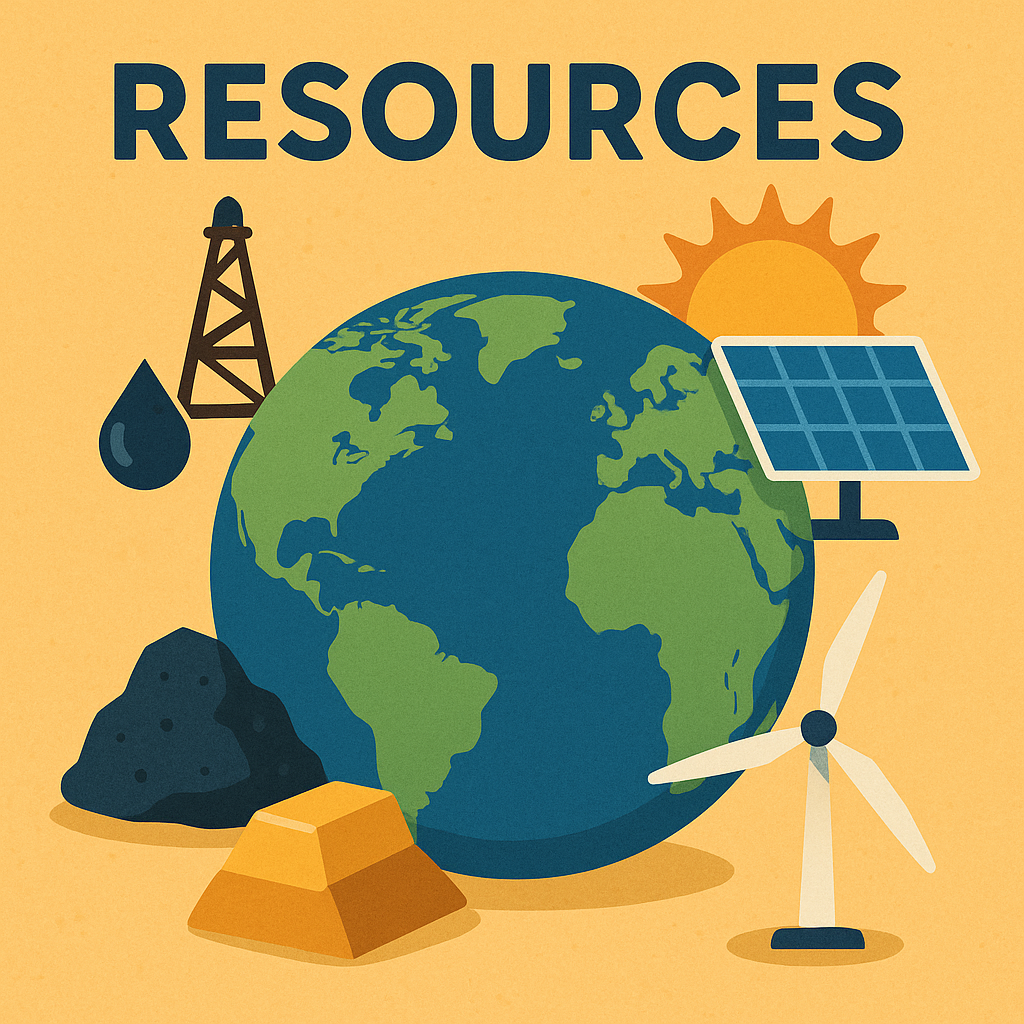
Chapter: Resources
- What is a Resource?
- A resource is anything that helps meet human needs and wants.
- Types of Resources:
- Natural resources: Found in nature like air, water, and soil.
- Man-made resources: Created by humans using natural materials, like buildings or machines.
- Value of Resources:
- A resource becomes valuable when humans know how to use it.
- Example: Iron ore became useful only when humans learned how to make tools and steel from it.
- Human Role:
- Humans give value to resources by using technology and skills to turn them into useful items.
- Story Context:
- Sweta asks Shreyas not to waste water.
- She shares how people in villages face water and electricity shortages.
- Sweta learned about the value of resources during a village trip.
- Message:
- We should use resources wisely.
- Many people don’t have access to clean water or electricity.
Classification of Resources
- Main Types of Resources:
- Natural resources: Come from nature (like air, water, sunlight, soil, forests).
- Human-made resources: Created by humans using natural materials.
- Human resources: People and their skills, knowledge, and abilities.
- Natural Resources Classification:
Natural resources can be grouped based on:- Origin:
- Biotic: Living things (plants, animals, humans).
- Abiotic: Non-living things (air, water, soil, sunlight).
- Continuity of Supply:
- Renewable: Can be replenished (sunlight, forests, water).
- Non-renewable: Cannot be replaced once used (coal, petroleum).
- Development Stage:
- Actual/Developed: Ready to use (we know how to use them).
- Potential: Not being used yet (we may use them in the future).
- Distribution:
- Ubiquitous: Found everywhere (air, sunlight).
- Localised: Found only in certain places (coal, gold).
- Important Terms:
- Renewable Resources: Can renew naturally or with help (forests, water, soil).
- Overuse and bad practices can reduce them.
- Problems: drying rivers, soil losing fertility, deforestation.
- Non-renewable Resources:
- These cannot be replaced once used.
- Examples: coal, petroleum, natural gas, and metallic minerals.
- Some take thousands or millions of years to form.
- Fossil fuels are non-renewable and cannot be recycled.
- Actual or Developed Resources:
- These resources are already discovered and used.
- We know their location, quantity, and quality.
- Examples: iron and coal in Jharkhand, diamond mines in South Africa, black soil in Maharashtra.
- Potential Resources:
- These could be useful in the future, but we aren’t using them yet.
- Reason: We may lack the technology or it may not be economical.
- Example: Biofuel was once ignored, now it’s important due to fuel price rise.
- Wind and solar energy were potential once, now they are actual.
- Ubiquitous Resources:
- Found everywhere.
- Examples: air, sunlight.
- Localised Resources:
- Found only in specific places.
- Examples: copper, iron ore, gold, silver.
- Human-made Resources:
- Created by humans using technology and skills.
- Natural materials are transformed into useful products.
Human Resources & Conservation
Human-made Resources:
- These are created by humans using skills and technology.
- Examples: aircrafts, roads, machines, buildings, schools, services like banking and transport.
Human Resources:
- People are the most important resource.
- They give value and meaning to all other resources.
- Human knowledge, creativity, and skill help produce useful products.
- Governments spend on education and health to improve human resources.
Conserving Resources:
- Human population is growing, so resource demand is increasing.
- Most human needs are met by natural resources:
- Food → soil, plants, animals
- Clothes → plant or animal fiber
- Shelter → timber, bricks, mortar, iron
- Industry → various minerals
- We cannot survive without natural resources.
- Non-renewable resources should not be overused or misused.
- If not used wisely, future generations may suffer from shortage.
Sustainable Development:
- Means meeting today’s needs without harming future generations’ needs.
- Using resources carefully for the future is called conservation of resources.
- Follow the 6 Rs of conservation (not listed here, likely in the next part).
I NOW KNOW – Answers
- What are resources?
- Resources are things that satisfy human needs and wants.
- Examples: Air, water, soil, coal, electricity, iron, human skills.
- Classification of resources:
Resources are mainly divided into:
- Natural resources – air, water, soil, forests.
- Human-made resources – roads, buildings, machines.
- Human resources – people and their knowledge, skills.
- Natural resources:
- Definition: Resources that come from nature.
- Types:
- Biotic (living): plants, animals.
- Abiotic (non-living): water, air, minerals.
- Renewable: forests, water, sunlight.
- Non-renewable: coal, petroleum, minerals.
- Actual: iron ore, coal (already in use).
- Potential: biofuel, wind energy (can be used in future).
- Ubiquitous: found everywhere (air, sunlight).
- Localised: found in few places (gold, copper).
- Human-made resources:
- Definition: Things humans make using natural resources and technology.
- Examples: Buildings, vehicles, computers, roads, factories.
- Human resources:
- Definition: People with their skills, knowledge, and creativity.
- Importance: They give value to all other resources and help create/manufacture things.
- Conserving resources:
- Why needed: To avoid shortage in the future due to overuse.
- Key ideas:
- Use non-renewable resources wisely.
- Protect nature to support future needs.
- Sustainable development: Using resources without harming the needs of future generations.
- Six Golden Rs of Conservation:
- Rethink
- Reduce
- Reuse
- Recycle
- Refuse
- Repair
Text book Excercise Answers
Multiple Choice Questions
- A resource can best be defined as:
- anything that can be used to satisfy human wants
- Which of the following statements about the metal silver is not correct?
- It can never be renewed or replenished in nature.
- Which of these according to you can pose a serious threat to a renewable resource like water? Why?
- Options i and iii, because they can affect the availability of water for years to come.
- Why is human resource said to be the most important resource?
- Humans have a creative mind
- Assertion (A): We should aim for sustainable development.
Reason (R): The future generations should have enough resources to meet their own needs.- Both A and R are true and R is the correct explanation of A.
- Which of the following pairs is correctly matched?
List I | List II |
a. Reduce | i. Buy only as much as you need |
b. Recycle | iv. Use cloth bags instead of plastic bags |
c. Refuse | ii. Plant saplings and take care of them |
d. Reuse | iii. Use a bucket of water to bathe |
- Correct Answer: a. Reduce – i. Buy only as much as you need
Distinguish Between:
- Biotic and Abiotic Resources
- Biotic: Living things (plants, animals, humans)
- Abiotic: Non-living things (air, water, soil, sunlight)
- Potential and Developed Resources
- Potential: Not being used yet but may be useful later (e.g., biofuel)
- Developed: Already in use and known in terms of quantity and quality (e.g., coal in Jharkhand)
- Renewable and Non-renewable Resources
- Renewable: Can be replaced naturally (e.g., water, sunlight)
- Non-renewable: Take millions of years to form and cannot be replaced easily (e.g., petroleum)
- Ubiquitous and Localised Resources
- Ubiquitous: Found everywhere (e.g., air, sunlight)
- Localised: Found in specific places only (e.g., gold, copper)
Answer in Brief:
- List the different types of natural resources.
- Biotic and Abiotic
- Renewable and Non-renewable
- Actual and Potential
- Ubiquitous and Localised
- What is sustainable development?
- It is development that meets the needs of the present without compromising the ability of future generations to meet their own needs.
- Is the technology of weaving cloth a human-made resource? Explain.
- Yes, because humans use their knowledge and machines to convert natural cotton or wool into cloth.
- What are the six golden Rs of conservation?
- Rethink, Reduce, Reuse, Recycle, Refuse, Repair
Answer in Detail:
- What are resources? Explain in detail.
- Resources are anything that satisfy human needs and wants. They can be natural (air, water), human-made (roads, machines), or human (skills, labor). Humans give value to resources by identifying and using them effectively.
- ‘Human needs and wants are satisfied primarily by nature.’ Justify.
- Nature provides food (plants, animals), shelter (wood, soil, stones), clothing (cotton, wool), and fuel (coal, petroleum). Without natural resources, human life would not be possible.
- Governments in some countries provide free education and healthcare. Why?
- To develop human resources. Educated and healthy citizens contribute more effectively to the country’s development.
- List some ways of conserving our resources.
- Switch off lights and fans when not in use
- Use buckets instead of showers
- Recycle and reuse materials
- Say no to plastic
- Plant trees and avoid cutting forests
VALUES Activity
List 3 values important for sustainable development with reasons:
MCQs: Resources Chapter
- What is a resource?
a) Anything found in nature
b) Anything that is bought and sold
c) Anything that satisfies human needs and wants
d) Only man-made items
✔️ Answer: c
Explanation: A resource is anything that helps fulfill human needs and wants. - Which of these is a natural resource?
a) Road
b) Plastic
c) Water
d) Electricity
✔️ Answer: c
Explanation: Water occurs naturally and is used by humans, so it is a natural resource. - Human-made resources are created using:
a) Sunlight
b) Technology and skills
c) Plants
d) Natural forces
✔️ Answer: b
Explanation: Humans use their knowledge and technology to make useful products. - Biotic resources are:
a) Non-living
b) Created by humans
c) Living, like animals and plants
d) None of these
✔️ Answer: c
Explanation: Biotic resources are living things. - Abiotic resources are:
a) Trees and animals
b) Soil, air, water
c) Humans
d) Machines
✔️ Answer: b
Explanation: Abiotic means non-living. - Which of these is renewable?
a) Petroleum
b) Forests
c) Gold
d) Coal
✔️ Answer: b
Explanation: Forests can regrow naturally if used carefully. - Which is a non-renewable resource?
a) Sunlight
b) Wind
c) Iron ore
d) Forest
✔️ Answer: c
Explanation: Iron ore cannot be replaced once used up. - Actual resources are:
a) Used in the future
b) Known and being used
c) Always natural
d) Local resources only
✔️ Answer: b
Explanation: Actual resources are those whose quantity and use is known. - Potential resources are:
a) Already being used
b) Found in small villages only
c) Not yet used, but may be useful in future
d) Always non-renewable
✔️ Answer: c
Explanation: Potential resources may become useful when we find ways to use them. - Which resource is found everywhere?
a) Coal
b) Gold
c) Air
d) Copper
✔️ Answer: c
Explanation: Air is a ubiquitous (everywhere) resource. - Localised resources are:
a) Found worldwide
b) Present only in labs
c) Found only in specific places
d) Renewable only
✔️ Answer: c
Explanation: Example: gold is found in only some regions. - Which of these is a human resource?
a) Machinery
b) People and their skills
c) Computers
d) Roads
✔️ Answer: b
Explanation: Human resource means people and their abilities. - Which is a human-made resource?
a) Forest
b) Cotton
c) Buildings
d) Fish
✔️ Answer: c
Explanation: Humans make buildings using natural materials. - Why are humans the most important resource?
a) They are many
b) They use other resources
c) They have creative minds
d) All of the above
✔️ Answer: d
Explanation: Humans give value to all other resources. - Which one is an example of sustainable action?
a) Using plastic bottles
b) Cutting down forests
c) Using cloth bags
d) Leaving tap open
✔️ Answer: c
Explanation: Cloth bags reduce plastic waste. - What does “reduce” mean in the 6 Rs?
a) Use more
b) Waste items
c) Use less and avoid waste
d) Buy more
✔️ Answer: c
Explanation: Reduce = consume less. - What does “reuse” mean?
a) Use something once
b) Throw away
c) Use again and again
d) Burn
✔️ Answer: c
Explanation: Reusing saves resources. - “Recycle” means:
a) Throw in the dustbin
b) Change waste into new products
c) Burn it
d) Leave it on road
✔️ Answer: b
Explanation: Recycling helps reduce waste. - Which of these is an abiotic renewable resource?
a) Wind
b) Gold
c) Iron
d) Diamond
✔️ Answer: a
Explanation: Wind is non-living but renewable. - Which of the following is NOT a resource?
a) Air
b) Sunlight
c) Cell phone signal
d) Laziness
✔️ Answer: d
Explanation: Laziness does not satisfy needs or wants. - What is meant by conservation of resources?
a) Using them quickly
b) Using them wisely
c) Avoiding them
d) None
✔️ Answer: b
Explanation: Conservation means saving and protecting. - Which resource takes millions of years to form?
a) Water
b) Petroleum
c) Air
d) Trees
✔️ Answer: b
Explanation: Fossil fuels take a long time to form. - What is the full form of 6 Rs in resource use?
a) Refuse, Reduce, Rethink, React, Recycle, Replace
b) Reduce, Reuse, Recycle, Rethink, Refuse, Repair
c) Remove, Reuse, Rethink, Recycle, React, Refuse
d) Rethink, Reuse, Refuse, Reform, Recycle, Respond
✔️ Answer: b
Explanation: These are the standard 6 Rs of conservation. - Which is an example of ‘refuse’?
a) Say yes to plastic bag
b) Use plastic bottle
c) Say no to plastic straw
d) Throw water
✔️ Answer: c
Explanation: Refuse means not using what is harmful. - Which is an example of ‘repair’?
a) Buying a new mobile
b) Fixing a broken fan
c) Using tissue
d) Throwing old clothes
✔️ Answer: b
Explanation: Repair extends the life of an item.
- Which activity helps in conserving resources?
a) Wasting paper
b) Leaving lights on
c) Using cloth bags
d) Taking long showers
✔️ Answer: c
Explanation: Cloth bags reduce plastic use. - Why should we conserve non-renewable resources?
a) They are everywhere
b) They replenish quickly
c) They take a long time to form
d) They are free
✔️ Answer: c
Explanation: Non-renewables like coal and oil form over millions of years. - Which of these is an example of sustainable development?
a) Cutting trees without planting
b) Using fossil fuels only
c) Meeting today’s needs without harming the future
d) Using up all water
✔️ Answer: c
Explanation: This is the definition of sustainability. - Which of these is NOT part of human-made resources?
a) Buildings
b) Machines
c) Railways
d) Soil
✔️ Answer: d
Explanation: Soil is a natural resource. - What does “ubiquitous” mean?
a) Expensive
b) Limited
c) Found everywhere
d) Non-renewable
✔️ Answer: c
Explanation: Ubiquitous means present everywhere. - Which of these can be both biotic and renewable?
a) Water
b) Forests
c) Petroleum
d) Gold
✔️ Answer: b
Explanation: Forests are living and can regrow. - Which of these is used for shelter and is a natural resource?
a) Plastic
b) Timber
c) Glass
d) Bricks
✔️ Answer: b
Explanation: Timber (wood) comes from trees. - Which is an example of resource overuse?
a) Using wind energy
b) Drip irrigation
c) Cutting all trees in a forest
d) Reusing clothes
✔️ Answer: c
Explanation: This is deforestation and harms sustainability. - What is the main source of human needs?
a) Nature
b) Machines
c) Money
d) Factories
✔️ Answer: a
Explanation: All needs like food, shelter, and clothes come from nature. - Why is overuse of water dangerous?
a) It causes floods
b) It can lead to scarcity
c) It increases rainfall
d) It makes water salty
✔️ Answer: b
Explanation: Overuse can dry up sources. - Which resource is used for both drinking and farming?
a) Petrol
b) Oil
c) Water
d) Coal
✔️ Answer: c
Explanation: Water is essential for life and agriculture. - Example of actual resource:
a) Solar energy in deserts
b) Coal in Jharkhand
c) Gold in Antarctica
d) Tidal energy
✔️ Answer: b
Explanation: It is already being mined and used. - Which of these resources is recyclable?
a) Fossil fuels
b) Plastic
c) Petrol
d) Natural gas
✔️ Answer: b
Explanation: Plastic can be melted and reused. - What is meant by “refuse” in the 6 Rs?
a) Throw items
b) Not use harmful things
c) Reuse bottles
d) Repair phones
✔️ Answer: b
Explanation: Refusing helps avoid waste. - What makes something a resource?
a) Money
b) People knowing how to use it
c) Machines
d) Age of item
✔️ Answer: b
Explanation: Humans add value by knowing how to use something. - Why do we need to conserve resources?
a) They are infinite
b) To save money
c) To ensure supply for future
d) To avoid electricity
✔️ Answer: c
Explanation: Conservation ensures availability for the next generations. - Which of these is not a use of natural resources?
a) Food
b) Fuel
c) Internet
d) Shelter
✔️ Answer: c
Explanation: Internet is a service, not a direct resource from nature. - What is “repair” in resource use?
a) Breaking things
b) Making new items
c) Fixing broken items to use again
d) Replacing items
✔️ Answer: c
Explanation: Repairs reduce the need to buy new. - What helps reduce water wastage?
a) Leaving taps on
b) Using a bucket to bathe
c) Watering plants daily
d) Filling swimming pools
✔️ Answer: b
Explanation: Buckets help control water use. - Which is not a type of natural resource classification?
a) Based on origin
b) Based on color
c) Based on development
d) Based on renewability
✔️ Answer: b
Explanation: Resources are not classified by color. - Which is a potential energy resource?
a) Biofuel
b) Petrol
c) Coal
d) Natural gas
✔️ Answer: a
Explanation: Biofuel is becoming more important now. - What does “sustainable development” focus on?
a) Fast growth
b) Using all resources now
c) Balanced use for present and future
d) Only technology
✔️ Answer: c
Explanation: It meets needs without harming future generations. - Which is the correct match for “Recycle”?
a) Say no to plastic
b) Fix broken phone
c) Use old newspapers
d) Make something new from waste
✔️ Answer: d
Explanation: Recycling is converting waste to useful items. - Why should we rethink before buying?
a) To avoid spending
b) To plan shopping
c) To avoid unnecessary resource use
d) To make lists
✔️ Answer: c
Explanation: Rethinking helps avoid buying what we don’t need. - Which resource is both renewable and ubiquitous?
a) Wind
b) Coal
c) Iron
d) Diamond
✔️ Answer: a
Explanation: Wind is renewable and found in many places.
25 Questions (2 Marks Each) with Answers
- What is meant by a resource?
Answer: A resource is anything that can be used to satisfy human needs and wants. - Define biotic and abiotic resources.
Answer:
- Biotic resources are living things like plants and animals.
- Abiotic resources are non-living things like soil, air, and water.
- Give two examples of renewable resources.
Answer: Water and sunlight. - Give two examples of non-renewable resources.
Answer: Coal and petroleum. - What are natural resources?
Answer: Natural resources are those that are obtained from nature, such as air, water, soil, minerals, and forests. - What are human-made resources?
Answer: Resources created by humans using technology, such as roads, machines, and buildings. - Define human resources.
Answer: Human resources refer to people and their skills, knowledge, and abilities. - Why are humans considered the most important resource?
Answer: Because they give value to all other resources and use them wisely. - What is sustainable development?
Answer: It is development that meets the needs of the present without harming the needs of future generations. - What do you understand by conservation of resources?
Answer: It means using resources carefully and wisely to ensure their availability for future generations. - Give two examples of ubiquitous resources.
Answer: Air and sunlight. - Give two examples of localised resources.
Answer: Gold and copper. - What are actual resources?
Answer: Resources that are being used currently and whose quantity and quality are known. - What are potential resources?
Answer: Resources that are not being used currently but may be used in the future with better technology. - State any two differences between renewable and non-renewable resources.
Answer:
- Renewable resources can be replenished; non-renewable cannot.
- Renewable are unlimited; non-renewable are limited in supply.
- Why should we use resources carefully?
Answer: To avoid their exhaustion and ensure they are available for future generations. - Mention two steps to conserve resources at home.
Answer:
- Switch off lights and fans when not in use.
- Use a bucket instead of a shower for bathing.
- What is meant by the term ‘Recycle’?
Answer: Converting used or waste materials into new useful products. - What is ‘Reuse’? Give an example.
Answer: Using an item multiple times instead of throwing it away.
Example: Reusing glass jars to store food. - Define ‘Reduce’ with an example.
Answer: Using fewer resources and avoiding waste.
Example: Buying only what you need. - What is meant by ‘Refuse’?
Answer: Saying no to items that are harmful or not needed, like plastic straws. - How do human beings add value to a resource?
Answer: By using their skills and knowledge to make them useful. - What is the meaning of the term ‘Rethink’?
Answer: To think carefully before buying or using something to avoid unnecessary use. - Name any two sectors where human-made resources are used.
Answer: Transport and education. - Why is overuse of non-renewable resources a problem?
Answer: Because they take millions of years to form and cannot be replaced once used up.
Match the Following – With Answers and Explanations
Question 1
Match the types of resources with examples:
Column A (Type) | Column B (Example) |
a. Biotic | i. Air |
b. Abiotic | ii. Cow |
c. Renewable | iii. Coal |
d. Non-renewable | iv. Sunlight |
Answer:
a – ii (Cow)
b – i (Air)
c – iv (Sunlight)
d – iii (Coal)
Explanation:
- Biotic = Living (Cow)
- Abiotic = Non-living (Air)
- Renewable = Can be replaced naturally (Sunlight)
- Non-renewable = Cannot be replaced quickly (Coal)
Question 2
Match the 6 Rs of conservation with their meanings:
Column A (R) | Column B (Meaning) |
a. Reuse | i. Say no to harmful items |
b. Recycle | ii. Use again instead of throwing |
c. Refuse | iii. Turn waste into something useful |
d. Repair | iv. Fix broken things |
Answer:
a – ii (Use again)
b – iii (Turn waste into something useful)
c – i (Say no)
d – iv (Fix broken things)
Explanation:
Each R represents a different way to reduce waste and protect resources.
Question 3
Match the resource types with their definitions:
Column A | Column B |
a. Actual resource | i. Can be used in future with technology |
b. Potential resource | ii. Already discovered and used |
c. Ubiquitous resource | iii. Found everywhere |
d. Localised resource | iv. Found only in certain areas |
Answer:
a – ii
b – i
c – iii
d – iv
Explanation:
Actual = In use; Potential = Not yet used; Ubiquitous = Everywhere; Localised = Limited places.
Question 4
Match the need with the resource used:
Column A (Need) | Column B (Resource) |
a. Food | i. Timber |
b. Shelter | ii. Soil, water, plants |
c. Clothing | iii. Cotton, wool |
d. Fuel | iv. Petroleum, coal |
Answer:
a – ii
b – i
c – iii
d – iv
Explanation:
Different basic needs depend on different types of natural resources.
Question 5
Match the term with its meaning:
Column A | Column B |
a. Sustainable development | i. Careful use of resources |
b. Conservation | ii. Resources created using technology |
c. Human-made resource | iii. Meeting needs without harming future |
d. Natural resource | iv. Resources from nature |
Answer:
a – iii
b – i
c – ii
d – iv
Explanation:
These terms define the different approaches and categories of resource use.
Would you like these questions turned into a classroom quiz or worksheet format (with blank columns)?
You said:
create 10 give reason questions with answers
ChatGPT said:
Here are 10 “Give Reason” questions with answers based on the “Resources” chapter:
Give Reason Questions with Answers
- Question:
We should use non-renewable resources carefully.
Answer:
Because they take millions of years to form and cannot be replaced once used up. Overusing them may lead to shortage in the future. - Question:
Sunlight is considered a renewable resource.
Answer:
Because it is continuously available and replenished naturally without human effort. - Question:
Air is called a ubiquitous resource.
Answer:
Because it is found everywhere on Earth and is essential for all living beings. - Question:
Human beings are considered the most important resource.
Answer:
Because they have the skills and knowledge to use other resources effectively and give them value. - Question:
Coal is classified as a non-renewable resource.
Answer:
Because it forms over millions of years and cannot be replaced once exhausted. - Question:
We should follow the 6 Rs of resource conservation.
Answer:
To reduce waste, protect the environment, and ensure that resources are available for future generations. - Question:
Forests can be both renewable and exhaustible.
Answer:
Because they can regrow if managed properly, but may be lost permanently if overused or destroyed. - Question:
Actual resources are more useful than potential resources.
Answer:
Because actual resources are already developed and in use, while potential resources may not be usable until future technology is available. - Question:
We must conserve water even though it is renewable.
Answer:
Because overuse and pollution can make water scarce or unusable in some areas, affecting people and agriculture. - Question:
Gold is a localised resource.
Answer:
Because it is found only in specific places and not evenly distributed around the world. - Responsibility – People must use resources wisely and avoid waste.
2. Respect for Nature – Protecting forests, rivers, and animals is essential for survival.
3. Cooperation – Everyone (citizens, governments, industries) must work together to conserve and protect resources.