Raising Achievers

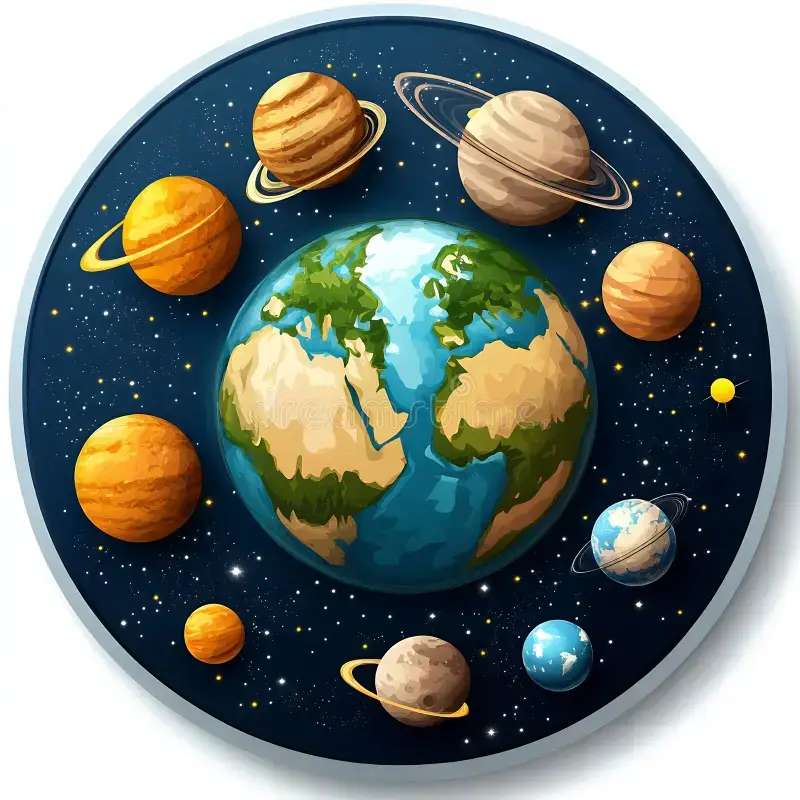
Earth in the Solar System


Key Points:

  • Earth is a planet in the solar system.
  • It spins on its axis and revolves around the Sun.
  • Earth receives light and heat from the Sun.
  • It is made up of land and water, surrounded by a layer of gases called the atmosphere.
  • Earth is the only known planet with life.

Heavenly Bodies (Celestial Bodies):

  • These include the Sun, stars, planets, and the Moon.
  • Seen in the sky from Earth.

Conditions that Support Life on Earth:

  • Water is essential for all life forms.
  • Earth lies in the habitable zone – the right distance from the Sun where liquid water can exist.
  • If Earth were:
    • Closer to the Sun: Water would evaporate.
    • Farther from the Sun: Water would freeze.
  • Earth has an average temperature of 14°C, ideal for life.

Fun Fact:

  • About two-thirds of the Earth is covered with water.
  • Earth is also called the Blue Planet.

The Shape of the Earth

  • Ancient people believed Earth was flat.
  • Now it’s proven: Earth is shaped like a sphere.
  • Evidence:
    • Ships return to starting point if they travel in one direction.
    • Shadow lengths at noon change with distance from the Equator.
    • When a ship arrives, we see its top first, not the whole ship.
    • Photos from space show Earth is round.
  • Earth is not a perfect sphere – it’s flattened at poles and bulging at the equator.
  • This shape is called a spheroid.


The Moon

  • Moon is Earth’s natural satellite.
  • Reflects sunlight, does not produce its own light.
  • Takes 27 days and 8 hours to orbit Earth.
  • We always see the same side of the Moon.
  • No air on the Moon, but traces of water have been found.
  • Surface is rocky and uneven, with many craters.
  • Moon changes shape/position as seen from Earth – these are phases of the Moon:
    • Full Moon: fully visible.
    • Then it wanes (gets smaller) daily.


Phases of the Moon

  • New Moon: Moon is not visible from Earth.
  • The Moon completes its phases in about 29.5 days (one lunar month).
  • The cycle goes from New Moon to Full Moon and back to New Moon.


The Sun and the Solar System

The Solar System:

  • Made up of the Sun and various objects that revolve around it:
    • Planets
    • Moons (satellites)
    • Asteroids
    • Comets
    • Meteors

The Sun:

  • The Sun is a star at the center of the solar system.
  • All planets and celestial bodies revolve around it.
  • About 4.6 billion years old.
  • Its gravitational field holds the solar system together.
  • Made of hot gases – mainly hydrogen and helium.
  • Surface temperature: around 5,500°C.
  • Diameter: 1,392,000 km (about 109 times bigger than Earth).
  • Distance between the Earth and Moon is less than half the Sun’s diameter.


The Planets

  • A planet is a celestial body that orbits the Sun.
  • There are eight major planets in the Solar System (in order from the Sun):
    Mercury, Venus, Earth, Mars, Jupiter, Saturn, Uranus, Neptune.
  • Common features of planets:
    • All are spherical in shape.
    • They do not emit their own light – they reflect sunlight.
    • Each planet rotates on its axis (one rotation = a day).
    • Each revolves around the Sun in an orbit (one revolution = a year).

Types of Planets:

  • Outer planets (Jovian planets): Jupiter, Saturn, Uranus, Neptune
    • Made of gases
    • Located far from the Sun
    • Cold in temperature
  • Inner planets (Terrestrial planets): Mercury, Venus, Earth, Mars
    • Made of rock and metals
    • Closest to the Sun
    • Earth is the largest among them
  • Most planets have moons (natural satellites)
    • Mercury and Venus have none
    • Earth has one moon
    • Saturn has many (about 145 moons)


Asteroids

  • Small celestial bodies between Mars and Jupiter.
  • Believed to be leftover debris from early Solar System formation or broken pieces of planets.
  • Also called planetoids.


Meteors

  • Also called meteoroids.
  • Chunks of rock moving at high speed around the Sun.
  • When they come near Earth, gravity pulls them in.
  • When meteoroids enter Earth’s atmosphere, they burn due to friction and become meteors or shooting stars.
  • If a meteor reaches the Earth’s surface, it leaves a crater.
  • Craters caused by meteor impacts can be seen in:
    • Ramagiri, Rajasthan
    • Lonar, Maharashtra
    • Arizona, USA


Stars, Constellations, and the Universe

Stars:

  • Huge balls of hot gases (mainly hydrogen and helium).
  • They are self-luminous – emit their own light and heat.
  • Formed from clouds of dust and gas that collapse under gravity and heat up.
  • Found in massive clusters called galaxies.
  • Our galaxy is called the Milky Way (Aakaash Ganga in Hindi).
  • The Sun is a star, closest to Earth.

Galaxies:

  • Large groups of stars, dust, and gas.
  • Millions of stars in one galaxy.
  • Billions of galaxies exist in the universe.


Comparison: Stars vs Planets

Stars

Planets

Emit their own light and heat

Reflect light from stars

Very hot

Temperature depends on distance from star

Twinkle when seen from Earth

Do not twinkle

Very large

Smaller in size

Example: Sun

Example: Earth


Constellations

  • Recognisable star patterns seen from Earth.
  • Often named after animals, people, or objects.


Constellations

  • Constellations are star patterns that resemble animals, people, or objects.
  • Common constellations:
    • Ursa Major (The Great Bear)
    • Orion (The Hunter)
    • Others: Canis Major, Leo, Taurus
  • Ursa Major is also called the Big Dipper.
    • Shaped like a large ladle (3 stars in handle, 4 in bowl).
    • Drawing a line from the last two stars of the bowl leads to the Pole Star (North Star or Dhruva Nakshatra).


Pole Star

  • Appears fixed in the night sky, above Earth’s rotational axis.
  • Used for navigation in ancient times.


Universe

  • Composed of:
    • Planets, stars, galaxies, dust clouds, dark matter, and energy.
  • Earth is a tiny part of the vast universe.


Words to Remember:

  • Gravity – Force pulling objects toward a planet/star.
  • Gravitational field – Region where gravity acts strongly.
  • Asteroid – Rocky object between Mars and Jupiter.
  • Meteor – Light streak from a meteoroid burning in atmosphere.
  • Meteoroid – Rock moving through space.
  • Star – Hot, glowing gas ball (e.g. Sun).
  • Galaxy – Massive star cluster (e.g. Milky Way).
  • Constellation – Star pattern resembling a figure.
  • Universe – All space, stars, planets, energy, and matter.


  1. Give one word for the following:
  2. The blanket of air surrounding the Earth: Atmosphere
  3. One complete orbit of a planet around the Sun: Planet year (or Revolution)
  4. The other name for asteroids: Planetoids
  5. Very large clusters of stars: Galaxy
  6. The Hindi name for the Milky Way Galaxy: Aakaash Ganga


  1. Differentiate between the following terms:
  2. Inner planets vs Outer planets
    • Inner planets: Mercury, Venus, Earth, Mars; rocky and small; closer to the Sun.
    • Outer planets: Jupiter, Saturn, Uranus, Neptune; made of gas; larger; farther from the Sun.
  3. Meteoroid vs Asteroid
    • Meteoroid: A small rocky body moving in space.
    • Asteroid: A larger rocky object orbiting the Sun, mainly between Mars and Jupiter.
  4. Meteors vs Meteorites
    • Meteors: Meteoroids that burn up in Earth’s atmosphere (shooting stars).
    • Meteorites: Meteors that survive the atmosphere and land on Earth.
  5. Star vs Planet
    • Star: Self-luminous body that emits its own light and heat (e.g., Sun).
    • Planet: Non-luminous body that orbits a star and reflects its light (e.g., Earth).

Unlock Unlimited Quiz Practice & Mock Tests – Only on Our App!

You’ve read the notes — now it’s time to test your knowledge!
✅ Attempt topic-wise quizzes,
✅ Take part in mock tests, and
✅ Join fun contests with leaderboards – all on the AchieversHunt Quiz App.

📲 Download now and boost your scores the smart way

Download App

Unlock Extra Practice & Exam Questions – Only on Our App!

You’ve got the notes right here on our website — now it’s time to level up your preparation!
📘 Access extra questions with answers, previous board exam questions, and exclusive chapter-based content in our AchieversHuntBooks e-book app.

📲 Download now and get exam-ready with confidence!

Download now
Facebook
WhatsApp
Telegram
Email
X
Threads