Earth’s Atmosphere
Definition of Atmosphere
- Air is a mixture of gases.
- The Earth is surrounded by an envelope of air called the atmosphere.
- The atmosphere has five layers that merge into each other without clear-cut boundaries.
Layers of the Atmosphere
- Troposphere (Lowest Layer)
- Closest to Earth’s surface and densest layer.
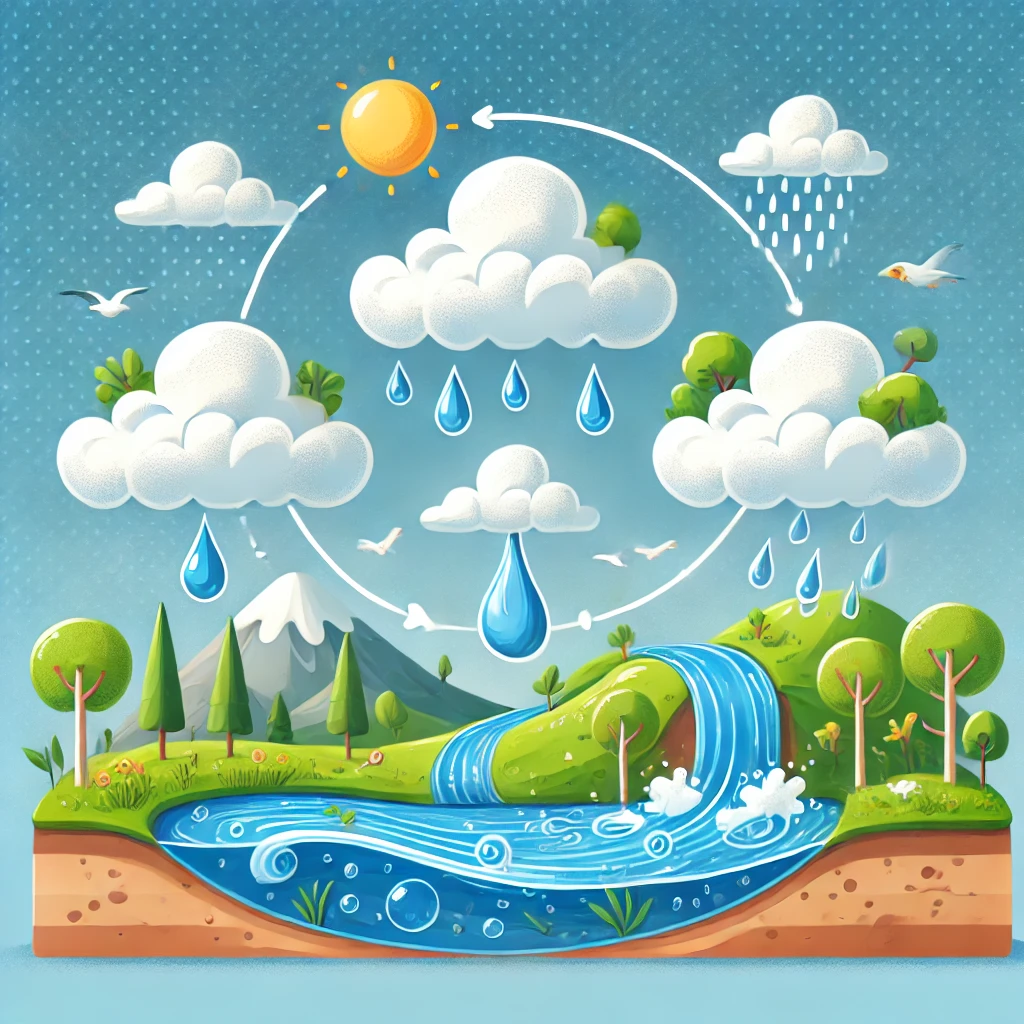
- Weather changes and water cycle occur here.
- The air we breathe is present in this layer.
- As we move higher, air becomes thinner, making breathing difficult.
- Stratosphere (Second Layer)
- Located above the troposphere.
- Less dense than the troposphere.
- Contains the ozone layer, which absorbs ultraviolet rays.
- Most aircraft fly in this layer as there are no weather disturbances.
- Mesosphere (Third Layer)
- Extends beyond the stratosphere.
- Meteoroids burn up in this layer before reaching Earth.
- Thermosphere (Fourth Layer)
- Space shuttles orbit in this layer.
- The ionosphere, a part of this layer, enables radio communication.
- Exosphere (Outermost Layer)
- The least dense layer, where air is very thin.
- No air beyond this layer—space begins after it.
Importance and Composition of Air
How is the Atmosphere Useful?
- The atmosphere contains oxygen for breathing and carbon dioxide for plant photosynthesis.
- It regulates Earth’s temperature, preventing overheating during the day and extreme cold at night.
- Weather changes and the water cycle occur within the atmosphere.
- It burns off meteoroids, preventing them from hitting Earth.
- The ozone layer in the stratosphere protects against harmful UV rays from the Sun.
- Sound waves need air to travel; without the atmosphere, communication would be impossible.
What is the Composition of Air?
- Air is a mixture of gases:
- Nitrogen (78%) – Most abundant gas, supports plant growth, and reduces fire spread.
- Oxygen (21%) – Essential for living beings and required for burning.
- Other Gases (1%) – Includes carbon dioxide, hydrogen, helium, ozone, and water vapor.
- Carbon dioxide – Used by plants for photosynthesis; released by animals and burning fossil fuels.
- Ozone – A special form of oxygen that blocks harmful ultraviolet radiation from the Sun.
- Humidity – Amount of water vapor in the air, varies by location (higher near the sea, lower in deserts).
Properties and Uses of Air
Properties of Air
- Air is invisible – It has no color, smell, or taste, but it is all around us.
- Air occupies space – When air is blown into a balloon, it expands, proving that air takes up space.
- Air has weight – An inflated balloon is heavier than a deflated one, showing that air has mass.
- Hot air expands and rises – This principle is used in hot air balloons.
- Air exerts pressure – Air pressure can hold objects in place and push liquids in different directions.
Test It Yourself Experiments
- Air has weight – A balanced ruler with two inflated balloons tilts when one balloon is burst, proving that air inside the balloon had weight.
- Air exerts pressure – Covering a water-filled glass with a card and turning it upside down keeps the card in place due to air pressure.
Uses of Air Pressure in Daily Life
- Drinking juice with a straw – Sucking air from the straw decreases pressure inside, and external air pressure pushes the liquid up.
- Using a medicine dropper – Pressing the dropper expels air, and releasing it allows air pressure to push liquid back in.
- Tyres in vehicles – Air pressure in tyres helps vehicles move smoothly.
Water on Earth & Water Safety
Where is Water Found on Earth?
- Earth is called the Blue Planet because over 70% of its surface is covered with water.
- Most water is in oceans and seas, which is salty and not usable for drinking.
- Freshwater is found in rivers, lakes, ponds, underground sources, and glaciers.
- Water in glaciers is frozen and not readily available for use.
- Rainwater seeps into the ground and collects above non-porous rocks, forming the water table.
- Areas with high rainfall have a higher water table.
- Water is essential for all living things—it is required for digestion, circulation, and excretion.
- Sources of drinking water include surface water (rivers) and groundwater (wells, tube wells).
- Groundwater may be unsafe as it can contain dirt and germs.
- The hydrosphere refers to all water, ice, and water vapor on or near Earth.
How Do We Make Water Safe?
- Impurities make water unsafe for drinking. Water containing impurities is called impure water.
- Types of impurities:
- Soluble impurities – Dissolve in water (e.g., salt, sugar).
- Insoluble impurities – Do not dissolve in water (e.g., sand, leaves).
Separating Impurities from Water
Methods of Separation
Different methods are used to separate soluble and insoluble impurities from water.
Separating Insoluble Impurities
- Common insoluble impurities: Sand and mud.
- Methods to remove them:
- Filtration –
- Water is passed through a filter (e.g., muslin cloth, filter paper).
- The filter allows liquid to pass while holding back insoluble particles.
- Example: Tea strainer is used to separate tea leaves.
- Sedimentation and Decantation –
- Sedimentation – Water containing sand or mud is left undisturbed, causing impurities to settle at the bottom.
- Decantation – The clear water is carefully poured out, leaving impurities behind.
Separating Soluble Impurities & Clean Water Supply
Separating Soluble Impurities
- Examples of soluble impurities: Salt and harmful chemicals.
- More difficult to remove than insoluble impurities.
- Methods of separation:
- Evaporation –
- Water is heated until it turns into water vapor, leaving behind solid impurities.
- Distillation –
- Used in laboratories to obtain pure water.
- Impure water is heated in a distillation flask until it turns into steam.
- Impurities remain in the flask.
- The steam cools in a condenser, turning back into water.
- The final water collected is distilled water, which is pure but lacks useful minerals.
Uses of Distilled Water
- Used in laboratories, medicines, and car batteries.
- Not suitable for drinking as it lacks essential minerals.
How Does Clean Water Reach Our Homes?
- Water from rivers is taken to water treatment plants for purification before it reaches homes.
Water Treatment Process
Steps in Water Purification at Treatment Plants
- Coagulation (Loading)
- Water is pumped from a river into large tanks.
- Chemicals like lime and alum are added to attract insoluble impurities (dirt, particles).
- These impurities clump together, making them easier to remove.
- Sedimentation
- The water is left undisturbed in large tanks.
- Heavier impurities settle at the bottom, forming sediment.
- Filtration
- Clear water is passed through filters made of sand, gravel, and charcoal.
- Small floating particles are removed during this stage.
- Chlorination
- Chlorine is added to the water to kill germs and bacteria.
- This process is called chlorination, and the treated water is known as chlorinated water.
- Storage and Distribution
- Chlorinated water is stored in large overhead tanks.
- It is then distributed to homes through pipes.
Note: Even after purification, water may not always be fit for drinking, so additional treatment may be needed at home.
Revision & Assessment
Objective Questions
- Multiple-Choice Questions (MCQs)
- Alum is added to water to attract insoluble impurities like dirt.
- Boiled water is not suitable for drinking as it lacks minerals.
- Fill in the Blanks
- Exosphere is the outermost layer of the atmosphere.
- Most meteoroids burn up in the Mesosphere.
- Nitrogen is the most abundant gas in air.
- Insoluble impurities do not dissolve in water.
- The process of adding chemicals to attract insoluble impurities is called coagulation.
- Circle the Odd One Out
- Exosphere (since it is not part of the lower atmosphere like mesosphere and troposphere).
- Evaporation (since it is not a filtering process like sedimentation and filtration).
- Seas (since lakes, rivers, and ponds contain freshwater).
- Chlorine (since oxygen, nitrogen, and carbon dioxide are natural atmospheric gases).
- Observe and Answer
- Label the layers of the atmosphere.
- Identify filtration and decantation processes.
Subjective Type Questions & Brief Answers
- What is the atmosphere? Name its layers.
- The atmosphere is a layer of gases surrounding Earth.
- Layers: Troposphere, Stratosphere, Mesosphere, Thermosphere, Exosphere.
- Two differences between troposphere and stratosphere.
- Troposphere: Weather changes occur; contains the air we breathe.
- Stratosphere: Ozone layer present; aircraft fly here due to stable conditions.
- Which impurities are harder to remove? Give two examples.
- Soluble impurities are more difficult to remove.
- Examples: Salt, harmful chemicals in water.
- What is a filter?
- A filter is a material that allows liquid to pass while trapping solid particles (e.g., filter paper).
- Why is distilled water not suitable for drinking?
- Distilled water lacks essential minerals needed for health.
- Why is chlorine added to water?
- Chlorine kills germs and bacteria to make water safe for drinking.
Answers to Exercise Questions
Experiential Learning: Designing a Simple Water Filter
Materials I used:
- A plastic bottle (cut in half)
- Cotton or cloth
- Sand
- Charcoal
- Gravel or small stones
This is what my filter looked like: (Draw a diagram of a water filter with layers of cotton, sand, charcoal, and gravel inside a bottle.)
Did the filter work? Yes / No
If Yes, why do you think it worked?
- The filter removed larger particles (like coriander powder) through layers of gravel, sand, and charcoal, leaving clearer water.
If No, why do you think it did not work as well as you thought it would?
- The filter may not have removed dissolved impurities or microorganisms, requiring further purification methods like boiling or chlorination.
Chapter Review Answers
Objective Type Questions
- Choose the correct answer:
(a) About 21% of air is made of this gas.
(b) This protects the Earth from harmful rays of the Sun.
(c) Weather changes take place in this layer.
- Answer: (iii) Troposphere
Objective Type Questions
- Multiple-Choice Questions:
- (d) This is added to water to attract insoluble impurities such as dirt particles.
- (e) Such water is not suitable for drinking.
- Fill in the Blanks:
- (a) Exosphere is the outermost layer of the atmosphere.
- (b) Most meteoroids burn up as they enter the Mesosphere.
- (c) Nitrogen is the most abundant gas in air.
- (d) Impurities that do not dissolve in water are called Insoluble impurities.
- (e) The process of adding chemicals to water to attract insoluble impurities is called Coagulation.
- Circle the Odd One Out:
- (a) Exosphere (as it is the outermost layer, while others are lower layers or related to Earth).
- (b) Evaporation (as it is not a purification process like sedimentation, chlorination, and filtration).
- (c) Seas (as lakes, rivers, and ponds contain freshwater, while seas contain saltwater).
- (d) Chlorine (as oxygen, nitrogen, and carbon dioxide are natural atmospheric gases, while chlorine is added to water).
Subjective Type Questions & Answers
- What is the atmosphere? Name its layers.
- The atmosphere is a layer of gases surrounding the Earth.
- Layers: Troposphere, Stratosphere, Mesosphere, Thermosphere, Exosphere.
- Write two differences between troposphere and stratosphere.
- Troposphere:
- Weather changes occur.
- Contains the air we breathe.
- Stratosphere:
- Contains the ozone layer that absorbs UV rays.
- Most aircraft fly here due to stable weather conditions.
- What kind of impurities are more difficult to remove from water? Give two examples.
- Soluble impurities are harder to remove.
- Examples: Salt, harmful chemicals.
- What is a filter?
- A filter is a material or device that separates solid particles from a liquid, allowing only the liquid to pass through.
- Example: Filter paper used in filtration.
- Why is distilled water not suitable for drinking?
- Distilled water lacks essential minerals required for health.
- Why is chlorine added to water?
- Chlorine kills germs and bacteria, making water safe for drinking.
Rewrite the Incorrect Sentences Correctly:
(a) Ozone prevents ultraviolet rays of the Sun from entering the atmosphere.
(b) Plants use carbon dioxide from the air to prepare their food.
(c) Filtration is used to separate insoluble impurities in water.
(d) Impure water is unclean water.
(e) The method of separating insoluble substances by allowing them to settle is called sedimentation.
Answer the Following in Detail:
(a) Describe the five layers of the atmosphere.
- Troposphere – Closest to Earth, where weather changes occur.
- Stratosphere – Contains the ozone layer that absorbs harmful UV rays.
- Mesosphere – Meteoroids burn up in this layer.
- Thermosphere – Space shuttles orbit here; ionosphere helps in radio communication.
- Exosphere – Outermost layer, where air is very thin, and space begins.
(b) Explain any three properties of air.
- Air occupies space – A balloon inflates when filled with air.
- Air has weight – An inflated balloon is heavier than a deflated one.
- Air exerts pressure – Air pressure helps us drink juice using a straw.
(c) Give two examples of how air pressure is useful in daily life.
- Drinking with a straw – Air pressure pushes the liquid into the straw.
- Inflating tyres – Air pressure helps vehicles run smoothly.
(d) Describe briefly how we can separate sand from water using:
- Sedimentation and Decantation – Letting water settle so sand collects at the bottom, then carefully pouring out clear water.
- Filtration – Passing the mixture through a filter to remove sand particles.
(e) Briefly explain the process of distillation.
- Water is heated in a distillation flask until it turns into steam.
- Steam rises, leaving impurities behind.
- The steam cools in a condenser and turns back into pure distilled water.
(f) Explain the steps in water treatment plants to purify water.
- Coagulation – Adding chemicals to attract dirt particles.
- Sedimentation – Letting heavy impurities settle.
- Filtration – Removing smaller particles through filters.
- Chlorination – Adding chlorine to kill germs.
- Storage – Storing purified water for distribution.
(g) Name two ways in which we can purify drinking water at home.
- Boiling – Kills germs and bacteria.
- Filtration – Removes insoluble particles.
Puzzle Over:
- What do you think would happen if there was no:
- Stratosphere – Harmful UV rays would reach Earth, causing damage to life.
- Mesosphere – Meteoroids would not burn up and could hit Earth.
- Troposphere – No oxygen for breathing, and no weather changes.
- Why are we asked not to burst crackers during festivals?
- Firecrackers release harmful gases and pollutants into the air.
- What will happen if the water table levels go down?
- Water scarcity will increase, leading to drought and affecting drinking water supply.
MCQs on Air and Water
- What is the Earth’s atmosphere?
- A) A layer of gases surrounding the Earth
B) A solid layer covering the Earth
C) A sheet of ice around the Earth
D) A vacuum around the Earth
✅ Answer: A) A layer of gases surrounding the Earth
📌 Explanation: The Earth’s atmosphere is a layer of gases that surrounds the planet and protects it by maintaining temperature and enabling life. - Which layer of the atmosphere is closest to Earth?
- A) Stratosphere
B) Troposphere
C) Mesosphere
D) Exosphere
✅ Answer: B) Troposphere
📌 Explanation: The troposphere is the lowest layer of the atmosphere where weather changes occur and the air we breathe is present. - Which layer of the atmosphere contains the ozone layer?
- A) Troposphere
B) Stratosphere
C) Mesosphere
D) Thermosphere
✅ Answer: B) Stratosphere
📌 Explanation: The stratosphere contains the ozone layer, which absorbs harmful ultraviolet rays from the Sun. - In which atmospheric layer do most meteoroids burn up?
- A) Mesosphere
B) Stratosphere
C) Troposphere
D) Exosphere
✅ Answer: A) Mesosphere
📌 Explanation: Most meteoroids burn up in the mesosphere due to friction with the air. - Which layer of the atmosphere is the outermost?
- A) Mesosphere
B) Stratosphere
C) Thermosphere
D) Exosphere
✅ Answer: D) Exosphere
📌 Explanation: The exosphere is the outermost layer of the atmosphere where air is very thin, and space begins. - Which gas is the most abundant in the Earth’s atmosphere?
- A) Oxygen
B) Carbon dioxide
C) Nitrogen
D) Ozone
✅ Answer: C) Nitrogen
📌 Explanation: Nitrogen makes up 78% of the Earth’s atmosphere, making it the most abundant gas. - What percentage of the atmosphere is made up of oxygen?
- A) 21%
B) 78%
C) 1%
D) 50%
✅ Answer: A) 21%
📌 Explanation: Oxygen constitutes about 21% of the Earth’s atmosphere, essential for respiration and combustion. - Why is the ozone layer important?
- A) It produces oxygen
B) It absorbs ultraviolet rays
C) It reflects sunlight
D) It cools the atmosphere
✅ Answer: B) It absorbs ultraviolet rays
📌 Explanation: The ozone layer in the stratosphere absorbs harmful UV rays from the Sun, protecting life on Earth. - Which process helps remove insoluble impurities like sand from water?
- A) Evaporation
B) Filtration
C) Distillation
D) Boiling
✅ Answer: B) Filtration
📌 Explanation: Filtration is the process used to remove insoluble impurities by passing water through a filter. - What is sedimentation?
- A) The addition of chemicals to water
B) Allowing heavy impurities to settle at the bottom
C) Heating water to remove impurities
D) Using a filter to remove small particles
✅ Answer: B) Allowing heavy impurities to settle at the bottom
📌 Explanation: Sedimentation is the process of allowing heavy impurities in water to settle at the bottom of a container. - What is decantation?
- A) Pouring out clean water after sedimentation
B) Adding chemicals to kill germs
C) Heating water to kill bacteria
D) Passing water through a filter
✅ Answer: A) Pouring out clean water after sedimentation
📌 Explanation: Decantation is the process of carefully pouring out the clean water after sedimentation, leaving impurities behind. - What is the process of adding chlorine to water called?
- A) Coagulation
B) Sedimentation
C) Chlorination
D) Filtration
✅ Answer: C) Chlorination
📌 Explanation: Chlorination is the process of adding chlorine to water to kill germs and make it safe for drinking. - Why is distilled water not suitable for drinking?
- A) It contains too many minerals
B) It lacks essential minerals
C) It has harmful bacteria
D) It is too acidic
✅ Answer: B) It lacks essential minerals
📌 Explanation: Distilled water is pure but lacks essential minerals required for human health. - What is the hydrosphere?
- A) The gaseous layer around Earth
B) All the water, ice, and vapor on Earth
C) The soil and landmass
D) The layer of air where planes fly
✅ Answer: B) All the water, ice, and vapor on Earth
📌 Explanation: The hydrosphere includes all the water bodies, ice, and water vapor on Earth. - Which method is used to separate soluble impurities like salt from water?
- A) Filtration
B) Sedimentation
C) Evaporation
D) Decantation
✅ Answer: C) Evaporation
📌 Explanation: Evaporation helps separate soluble impurities by converting water into vapor and leaving impurities behind. - What is the main source of drinking water for most people?
- A) Ocean water
B) Glaciers
C) Rivers and groundwater
D) Rainwater
✅ Answer: C) Rivers and groundwater
📌 Explanation: The main sources of drinking water are surface water from rivers and lakes, as well as groundwater from wells and tube wells. - Which process removes small floating particles from water?
- A) Sedimentation
B) Filtration
C) Evaporation
D) Decantation
✅ Answer: B) Filtration
📌 Explanation: Filtration removes small floating particles from water by passing it through materials like sand, gravel, and charcoal. - What happens in sedimentation tanks at water treatment plants?
- A) Water is heated to remove bacteria
B) Chemicals are added to purify water
C) Heavy impurities settle at the bottom
D) Water is passed through filters
✅ Answer: C) Heavy impurities settle at the bottom
📌 Explanation: In sedimentation, heavy impurities settle down at the bottom of the tank, allowing clearer water to be separated. - Which gas is essential for respiration?
- A) Nitrogen
B) Carbon dioxide
C) Hydrogen
D) Oxygen
✅ Answer: D) Oxygen
📌 Explanation: Oxygen is required by all living organisms for breathing and is present in 21% of the atmosphere. - How do meteoroids burn up in the atmosphere?
- A) Due to lack of oxygen
B) Due to high speed
C) Due to friction in the mesosphere
D) Due to gravitational force
✅ Answer: C) Due to friction in the mesosphere
📌 Explanation: Most meteoroids burn up in the mesosphere due to air resistance and friction, preventing them from reaching Earth’s surface. - Which component of air is used by plants for photosynthesis?
- A) Oxygen
B) Carbon dioxide
C) Nitrogen
D) Ozone
✅ Answer: B) Carbon dioxide
📌 Explanation: Plants absorb carbon dioxide from the atmosphere to prepare food through photosynthesis. - What helps in communication through radio waves?
- A) Troposphere
B) Exosphere
C) The ionosphere in the thermosphere
D) Stratosphere
✅ Answer: C) The ionosphere in the thermosphere
📌 Explanation: The ionosphere, a part of the thermosphere, reflects radio waves back to Earth, enabling communication. - Why is air pressure important?
- A) It allows us to see things clearly
B) It helps in drinking juice using a straw
C) It prevents water from evaporating
D) It makes the air heavier
✅ Answer: B) It helps in drinking juice using a straw
📌 Explanation: When we suck air from a straw, the pressure inside decreases, and external air pressure pushes the liquid into the straw. - Which atmospheric layer is free from weather disturbances?
- A) Troposphere
B) Stratosphere
C) Mesosphere
D) Exosphere
✅ Answer: B) Stratosphere
📌 Explanation: The stratosphere is above the troposphere, where no weather disturbances occur, making it ideal for aircraft travel. - Why is boiling an effective method of water purification?
- A) It removes all impurities
B) It kills bacteria and germs
C) It removes salt from water
D) It adds minerals to water
✅ Answer: B) It kills bacteria and germs
📌 Explanation: Boiling water at high temperatures kills bacteria and germs, making it safe for drinking. - What happens to air as we go higher in the troposphere?
- A) It becomes denser
B) It remains the same
C) It becomes thinner
D) It turns into water vapor
✅ Answer: C) It becomes thinner
📌 Explanation: As altitude increases, air pressure and oxygen levels decrease, making breathing more difficult. - Why does water in glaciers remain unavailable for direct use?
- A) It is in solid form (frozen)
B) It is too pure
C) It is highly acidic
D) It contains a lot of salt
✅ Answer: A) It is in solid form (frozen)
📌 Explanation: Water in glaciers is frozen and not easily accessible for drinking or agricultural use. - What is the main function of the exosphere?
- A) It protects Earth from meteors
B) It marks the beginning of space
C) It contains the ozone layer
D) It helps in the water cycle
✅ Answer: B) It marks the beginning of space
📌 Explanation: The exosphere is the outermost layer of the atmosphere where air is very thin, and space begins. - Which gas in the air helps in burning?
- A) Nitrogen
B) Carbon dioxide
C) Oxygen
D) Ozone
✅ Answer: C) Oxygen
📌 Explanation: Oxygen supports combustion, making it essential for burning fuels. - How does clean water reach our homes?
- A) Through water treatment plants and pipelines
B) Directly from rivers
C) Through underground volcanic activity
D) By collecting rainwater
✅ Answer: A) Through water treatment plants and pipelines
📌 Explanation: Water from rivers is treated in purification plants before being stored and distributed to homes through pipelines.
Two-Marks Questions and Answers on Air and Water
- What is the atmosphere?
The atmosphere is a layer of gases surrounding the Earth that protects life by regulating temperature, enabling breathing, and supporting weather changes.
- Name the five layers of the atmosphere.
The five layers of the atmosphere are:
- Troposphere
- Stratosphere
- Mesosphere
- Thermosphere
- Exosphere
- Why is the ozone layer important?
The ozone layer, found in the stratosphere, absorbs harmful ultraviolet (UV) rays from the Sun, protecting life on Earth from radiation damage.
- How does air pressure help in daily life?
Air pressure helps in many ways, such as:
- Drinking through a straw – Air pressure pushes liquid into the straw when we suck.
- Inflating tyres – The air inside tyres supports vehicles and helps them move smoothly.
- What is sedimentation and decantation?
- Sedimentation is the process of allowing heavier impurities to settle at the bottom of water.
- Decantation is carefully pouring out the clear water, leaving impurities behind.
- How does filtration help in purifying water?
Filtration removes insoluble impurities by passing water through materials like sand, gravel, and charcoal. It is used in water purification systems.
- Why is boiling water a good purification method?
Boiling water kills germs, bacteria, and harmful microorganisms, making it safer to drink.
- What is chlorination?
Chlorination is the process of adding chlorine to water to kill harmful bacteria and germs, making it safe for drinking.
- Why is nitrogen the most abundant gas in the atmosphere?
Nitrogen makes up 78% of the atmosphere and is essential for plant growth as it helps in the formation of proteins and other compounds.
- What happens to air as we move higher in the troposphere?
As we move higher in the troposphere, air becomes thinner, and oxygen levels decrease, making it harder to breathe.
- What is the role of the ionosphere in communication?
The ionosphere, part of the thermosphere, reflects radio waves back to Earth, enabling long-distance communication.
- What is the hydrosphere?
The hydrosphere includes all of Earth’s water bodies such as oceans, rivers, lakes, groundwater, ice caps, and water vapor in the atmosphere.
- Why is distilled water not suitable for drinking?
Distilled water is pure but lacks essential minerals required for human health, making it unsuitable for drinking.
- How do water treatment plants purify water?
Water treatment plants purify water in five steps:
- Coagulation – Chemicals like alum are added to attract dirt particles.
- Sedimentation – Heavy particles settle at the bottom.
- Filtration – Water is passed through layers of sand and gravel.
- Chlorination – Chlorine is added to kill germs.
- Storage – Clean water is stored and supplied through pipelines.
- Why is the mesosphere important for Earth’s protection?
The mesosphere burns up meteoroids before they reach Earth, protecting the planet from frequent meteor impacts.
50 Fill in the Blanks Questions with Answers
- The Earth is surrounded by a layer of gases called the ___ .
✅ Answer: Atmosphere - The ___ is the outermost layer of the atmosphere.
✅ Answer: Exosphere - Most meteoroids burn up in the ___ layer of the atmosphere.
✅ Answer: Mesosphere - The ___ layer contains the ozone layer, which protects us from harmful UV rays.
✅ Answer: Stratosphere - Weather changes and the water cycle occur in the ___ layer of the atmosphere.
✅ Answer: Troposphere - The gas that makes up 78% of the Earth’s atmosphere is ___ .
✅ Answer: Nitrogen - About 21% of the atmosphere is composed of ___ .
✅ Answer: Oxygen - The process of adding chlorine to water to kill germs is called ___ .
✅ Answer: Chlorination - The process of allowing heavier particles to settle at the bottom of water is called ___ .
✅ Answer: Sedimentation - The process of carefully pouring out the clear water after sedimentation is called ___ .
✅ Answer: Decantation - The ozone layer is found in the ___ layer of the atmosphere.
✅ Answer: Stratosphere - Filtration is used to remove ___ impurities from water.
✅ Answer: Insoluble - The process of removing soluble impurities like salt from water is called ___ .
✅ Answer: Evaporation - The hydrosphere consists of all the ___ on Earth.
✅ Answer: Water - Water is taken from rivers to water treatment plants for ___ .
✅ Answer: Purification - Air is a mixture of gases, mainly nitrogen, oxygen, and ___ .
✅ Answer: Carbon dioxide - Plants use ___ from the air to prepare their food through photosynthesis.
✅ Answer: Carbon dioxide - The ___ in the thermosphere reflects radio waves back to Earth.
✅ Answer: Ionosphere - The process of boiling water helps in ___ harmful bacteria and germs.
✅ Answer: Killing - The process of heating impure water to form steam and then cooling it back to pure water is called ___ .
✅ Answer: Distillation - The exosphere marks the beginning of ___ .
✅ Answer: Space - The gas required for respiration in humans and animals is ___ .
✅ Answer: Oxygen - Meteoroids burn up in the mesosphere due to ___ .
✅ Answer: Friction - The process of passing water through sand, charcoal, and gravel to remove particles is called ___ .
✅ Answer: Filtration - The addition of chemicals like alum to attract dirt particles in water is called ___ .
✅ Answer: Coagulation - The air pressure in a ___ helps vehicles run smoothly.
✅ Answer: Tyre - The part of the atmosphere where weather changes take place is called the ___ .
✅ Answer: Troposphere - The ___ is a layer of gases that surrounds Earth and supports life.
✅ Answer: Atmosphere - Air pressure helps us drink liquid using a ___ .
✅ Answer: Straw - The percentage of nitrogen in the air is ___ .
✅ Answer: 78% - The presence of excessive ___ in the atmosphere can cause air pollution.
✅ Answer: Carbon dioxide - The water in glaciers is mostly in ___ form.
✅ Answer: Frozen - Distilled water lacks essential ___ .
✅ Answer: Minerals - The main source of drinking water is ___ and groundwater.
✅ Answer: Rivers - Water is purified before reaching our homes through ___ .
✅ Answer: Treatment plants - The process of separating water from dissolved salts by heating is called ___ .
✅ Answer: Evaporation - The exosphere contains very ___ air.
✅ Answer: Thin - ___ is used in car batteries and laboratories but is not suitable for drinking.
✅ Answer: Distilled water - Rainwater that seeps into the ground collects above non-porous rocks, forming the ___ .
✅ Answer: Water table - The process of sedimentation followed by filtration helps in removing ___ particles from water.
✅ Answer: Suspended - Chlorination is the process of adding chlorine to water to ___ bacteria.
✅ Answer: Kill - The exosphere is the ___ layer of the atmosphere.
✅ Answer: Outermost - The ozone layer protects life on Earth by blocking harmful ___ rays.
✅ Answer: Ultraviolet - The movement of water between the atmosphere, land, and oceans is known as the ___ .
✅ Answer: Water cycle - Air becomes ___ as we go higher up in the atmosphere.
✅ Answer: Thinner - Plants absorb ___ from the soil with the help of roots.
✅ Answer: Water - Most aircraft fly in the ___ layer as there are no weather disturbances.
✅ Answer: Stratosphere - The process of turning water into vapor and then cooling it back into liquid is called ___ .
✅ Answer: Condensation - The gas that helps in burning is ___ .
✅ Answer: Oxygen - The ionosphere is a part of the ___ layer of the atmosphere.
✅ Answer: Thermosphere